

Part 8: Session Seven – Building a Portable Toolkit
What holds you steady when the ground shifts

Room 214 didn’t feel quite the same. The circle felt a little more grounded than it had last week, but only just a little. They had shared so much together, and now Jonas was gone. His absence left a space behind, not empty, exactly, but filled with the quiet weight of his presence still being felt and remembered.
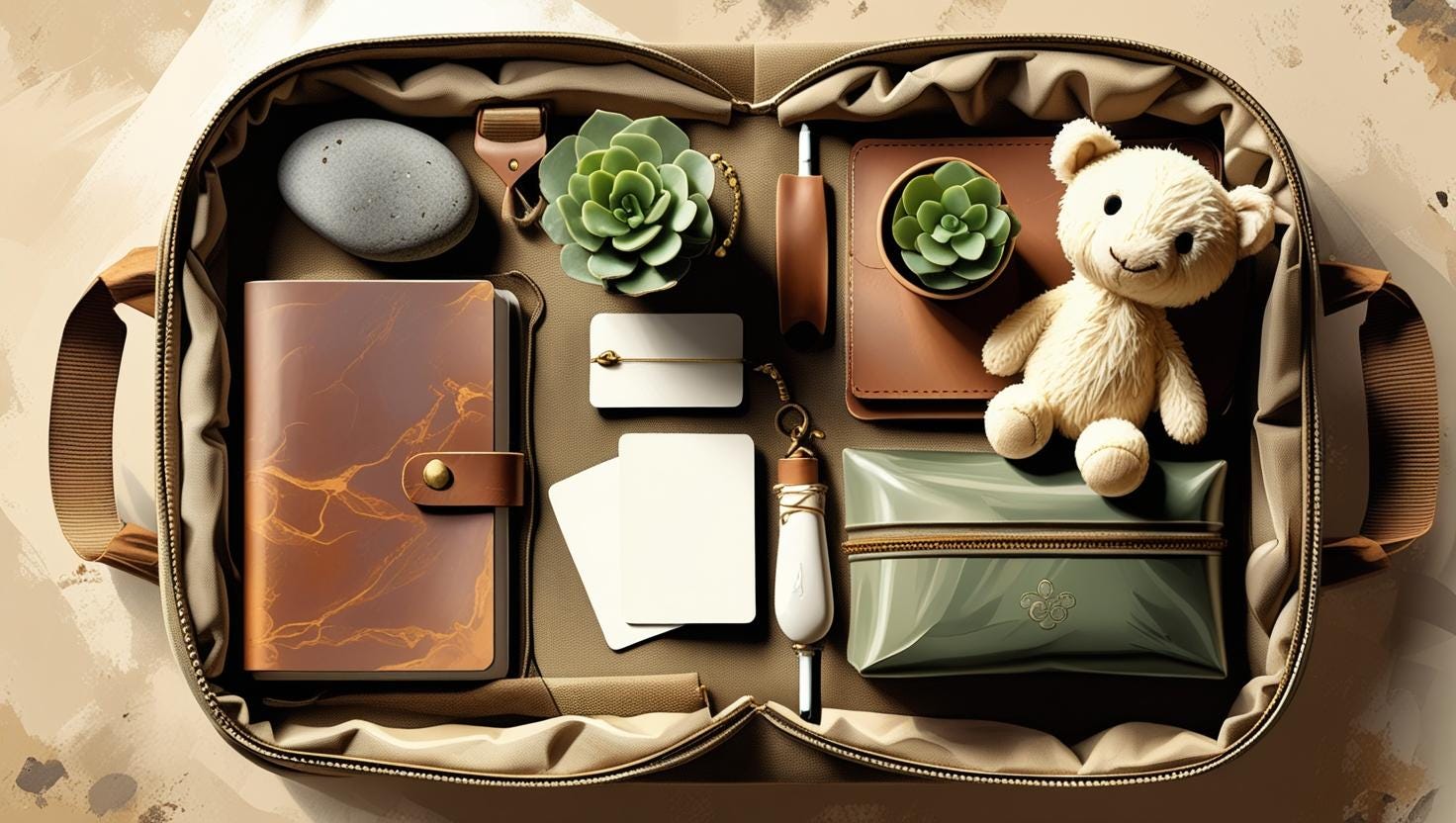
Mr. Elias arrived on time with a canvas bag and a big smile.
"Today," he said, placing the bag on the table, "we're going to talk about what helps in difficult situations. What anchors us when everything else is in motion."
He reached in and began pulling out objects: a smooth stone, a small bottle of lavender oil, a worn-out deck of cards, and an old photograph.
"These," he said, "are pieces from my own portable toolkit. It’s not literal luggage, but things I carried across countries and years. Some reminded me of home. Some helped me breathe easier in strange places. Some made me feel like myself again."
He passed the objects around.
"You each have tools, too. They might not be obvious, but you already use them. Today, we are going to name them."
They spent time quietly making a list of things that helped them feel calm, safe, and strong. These weren’t just just objects, but actions, people, habits, and practices.
Lina drew a playlist with ten songs and a sketchbook.
"When I’m in a new place, I can put my headphones in and start to draw. That makes me feel like myself."
Samir added a small stack of Polaroids and a specific brand of chai.
"It sounds small, but when I make it, everything smells like home."
Kai wrote: pacing when I need to think, journaling stuff he doesn’t talk about, his mom’s soup recipe, FaceTiming his cousin at weird hours.
“It’s not just stuff,” he said, shrugging a little. “It’s the kind of stuff that makes me feel normal again when everything else around me is new or confusing. Like, these are the things that remind me of who I am.”
Rina held up a pair of socks.
"These aren’t just any socks," she grinned. "These are my airport socks. I wear them every time I leave one country for another. They're kind of like my travel armor."
They all laughed. It was the kind of laugh that drew people together and made them feel more comfortable.
Mr. Elias nodded.
"Good. These are not escape routes. They're support systems. Reminders."
He added gently, "We can't always control when the next move or transition comes. But we can prepare. And part of that is knowing what helps."
He closed with a quote:
"You don’t have to feel brave to start. You just have to begin. And sometimes, your smallest habits are your loudest courage."
🧠 Coping Tool: Portable Coping Plan
Each student created a "Portable Toolkit" using drawings, photos, or lists filled with the sensory tools, emotional anchors, and comforting practices they turn to during difficult transitions. These are internal suitcases. They are personalized, reliable, and ready to carry with them wherever life takes them.
Homework: Make a real version of your toolkit. Put it in a box, a folder, a playlist, or a journal. Add to it over time. Then, write a short note to yourself: "What I need when things get hard."
▌Coming Next: Session Eight — Roots and Routes
In the next session, the group reflects on how their journeys have shaped who they are and what they've gained along the way. They explore both the roots they’ve carried and the new paths beginning to take shape.
As someone who moved to another country and between cities, I can deeply relate to it. It's crucial to keep something with you from the past to make the transition smoother and stay sane. Peace!
I got homework to do 🤍